fewer model calls
1,344 gated versus 2,000 always-on
Make every inference earn its compute.
GnoSys evaluates heterogeneous sensor evidence locally, decides which downstream model paths are eligible, and preserves a replayable record of every decision before heavier GPU, cloud, or human attention is invoked.
No model retraining. Operator authority remains with the integrating system.
Frozen physical evaluation
A physical UNO R4 gated a frozen 2,000-window UNSW-NB15 holdout through NVIDIA Holoscan 4.5.0 on one Tesla T4. The decision threshold was selected outside the holdout.
1,344 gated versus 2,000 always-on
0.9074 on the always-on arm
0.2601 on the always-on arm
2,007 receipts plus 3 operating records
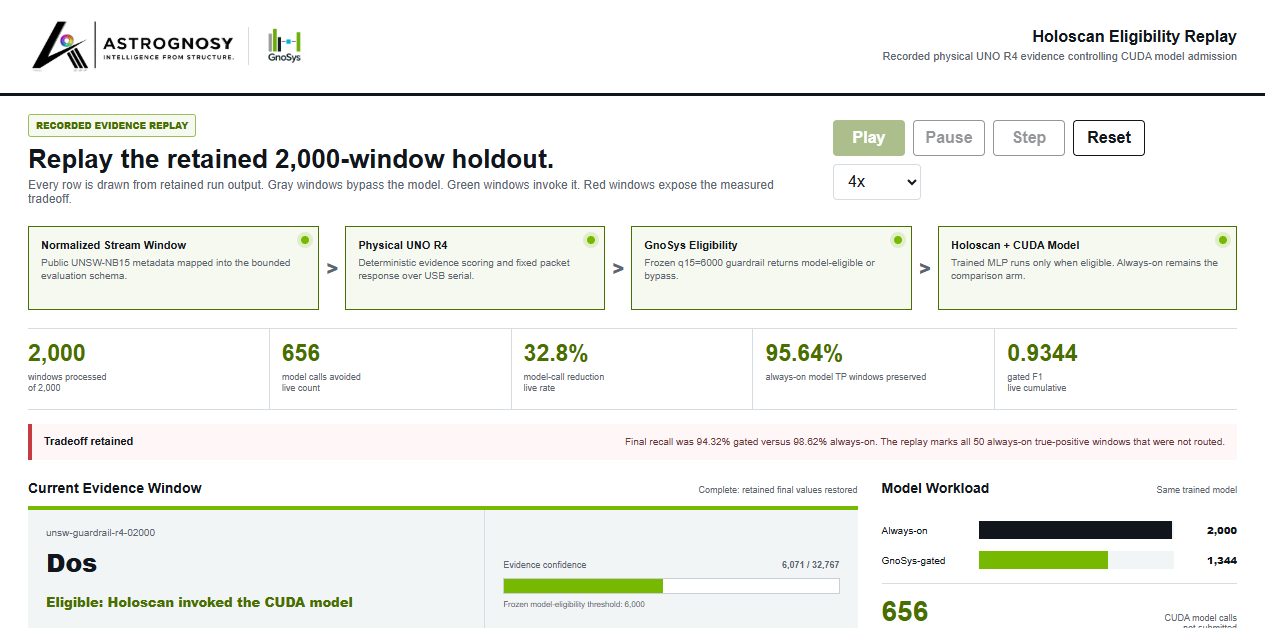
Recall moved from 98.62% always-on to 94.32% gated, and 50 always-on true-positive windows were suppressed. Avoided calls are measured; direct energy, cost, GPU-time, and customer ROI savings are not claimed by this run.
A small layer before heavy inference
GnoSys does not replace partner models or orchestrators. It adds a deterministic eligibility decision at the point where raw activity becomes an inference task, event, or operational review.
A local adapter maps sensor, network, time-series, vision, latent, or token-stream state into a bounded input.
The portable C core evaluates evidence and selects a route under frozen policy.
A fixed-format packet records what the system observed, decided, and authorized.
The integrating system can bypass, invoke one model, activate fusion, escalate, or fail safe.
Where it fits
The initial commercial focus is selective physical-AI inference, where multiple sensor and model paths compete for constrained compute, bandwidth, power, or operator attention.
Screen windows before vision, fusion, remote inference, or human review is activated.
Turn normalized structural events into replayable eligibility and escalation decisions.
Keep routine equipment state local while escalating material departures to heavier analysis.
Evaluate bounded model state before additional experts, agents, or remote compute are called.
Sensor to accelerated stack
The product is the evidence and eligibility contract. MCU, Linux edge, Holoscan, GPU, and future silicon targets are deployment surfaces for that same contract.
Bounded scoring and evidence encoding on a supported low-resource target after upstream normalization.
A portable, deterministic kernel beside existing sensor gateways and local inference stacks.
GnoSys determines eligibility before selected downstream CUDA model paths execute.
Astrognosy is a member of NVIDIA Inception. GnoSys is independently developed and is not presented as an NVIDIA-endorsed product.
Commercial path
Start with one bounded inference workflow and a frozen always-on comparison. Keep partner models, data, and production authority unchanged while the evaluation records every invoke and suppression decision.
A controlled shadow evaluation on one real workload.
Deploy the eligibility kernel and evidence contract after workload validation.
Integrate the decision substrate into sensor, gateway, firmware, FPGA, or chip-adjacent systems.
Founding partner evaluations